What Are the Top 10 China Narrow Aisle Storage Brands?

Time:2026-10-02 Author:Mason
0%

Choosing the right Narrow Aisle Storage brand can reshape warehouse capacity, safety, and daily productivity. A well-designed system may turn a crowded 10,000-square-meter facility into a more controlled working environment. Forklifts move through tighter aisles, pallets sit higher, and every maneuver matters.

As warehouse strategist James A. Tompkins has said, “The warehouse is the heart of the supply chain.” His observation applies directly to narrow aisle operations. Storage equipment affects picking speed, inventory accuracy, operator confidence, and long-term operating costs. This article examines ten leading China Narrow Aisle Storage brands through practical criteria, including aisle utilization, rack stability, forklift compatibility, load capacity, customization, after-sales service, and manufacturing consistency.

The ranking is not perfectly objective. It should not be.

Different warehouses need different answers. A cold-storage operator may value corrosion resistance and battery performance. An e-commerce facility may prioritize rapid picking and flexible configurations. A manufacturing plant may require heavier loads, strict safety controls, and integration with existing material-handling equipment. Brand visibility alone does not prove engineering quality.

The selected companies are assessed using available product information, industry reputation, application experience, and customer-support capability. We also consider details that are easy to overlook, such as beam deflection, floor tolerance, turning radius, protective guards, and maintenance access. Small design choices can create large operational differences.

Readers should verify specifications before making a purchase. Rack dimensions, load ratings, local installation requirements, and service coverage must match the actual site. This guide offers a practical starting point, not a substitute for professional warehouse planning.
What Are the Top 10 China Narrow Aisle Storage Brands?

Narrow Aisle Storage: Definition, Uses, and Key Features

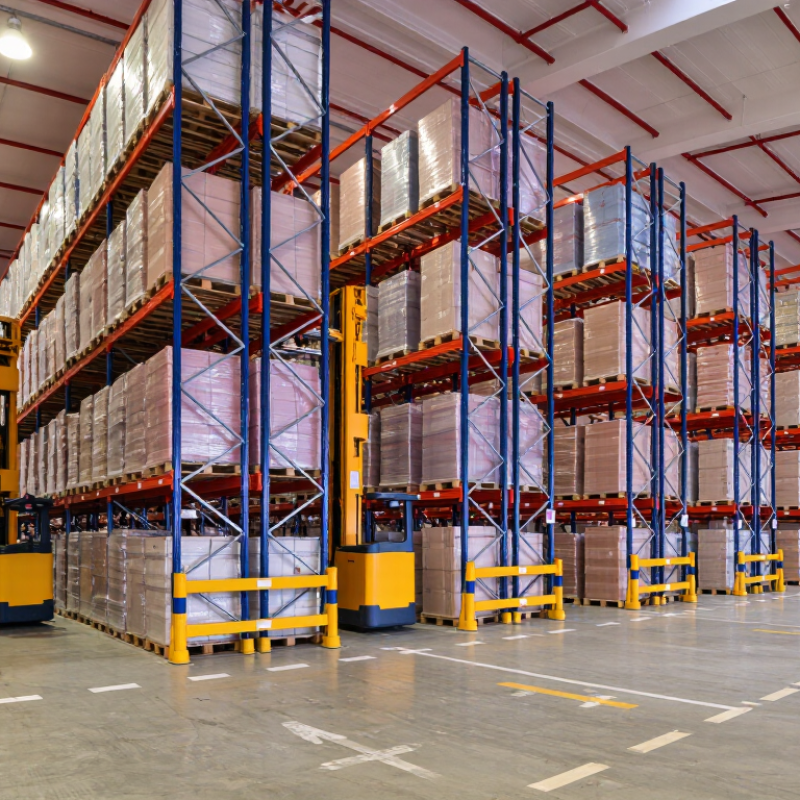
Narrow aisle storage is a warehouse system designed to increase pallet capacity within limited floor space. It uses slimmer aisles than conventional racking. Specialized lift trucks reach pallets at greater heights. In many facilities, aisle widths range from 1.5 to 2 meters, depending on equipment and load dimensions. The goal is simple: store more inventory without expanding the building.

This system suits distribution centers, cold storage rooms, spare-parts warehouses, and manufacturing sites with high stock density. Its key features include adjustable beam levels, vertical storage, guided truck movement, and selective pallet access. Some layouts use floor rails or wire guidance to improve truck accuracy. Strong rack frames are essential when loads are heavy or frequently moved. Clear safety barriers also protect rack legs from vehicle impact. Small details matter here.

TOP TENWhen comparing the top ten China narrow aisle storage brands, buyers should examine engineering quality rather than catalog claims. Check load calculations, steel thickness, surface treatment, installation training, and replacement support. A practical test should measure turning space, retrieval time, and operator visibility. One overlooked issue is floor flatness. Uneven floors can reduce truck stability and damage guidance equipment. Narrow aisles also demand disciplined inventory control. A misplaced pallet can block an entire lane. This is not a perfect solution. Higher density may reduce flexibility for irregular loads. Careful planning remains necessary.

How China’s Narrow Aisle Storage Brands Are Evaluated

Evaluating China’s top 10 narrow aisle storage brands requires more than comparing prices. A reliable assessment begins with warehouse experience, engineering evidence, and documented customer results. The strongest suppliers show aisle widths, load ratings, lift heights, and turning requirements in clear technical documents. They also explain how their systems perform under daily forklift movement, not only in showroom conditions.

Safety deserves close attention. Reviewers should check structural calculations, weld quality, surface treatment, emergency access, and inspection procedures. Independent testing and recognized certifications can support these claims, but certificates alone are not enough. Ask for installation records, maintenance schedules, spare-parts availability, and response times. A practical test may include loaded pallets, uneven traffic, and repeated picking cycles. Small details matter, such as beam deflection after several hours of use.

Cost remains important, yet the lowest quotation can hide future expenses. Compare energy use, floor utilization, training needs, software compatibility, and replacement components. Speak with current users when possible. Their comments may reveal noise, difficult controls, or delayed technical support. No scorecard is perfect. I would revise the ranking after a site visit, because drawings cannot show every real-world weakness. A dependable evaluation balances measurable performance with honest field feedback.

Top 10 China Narrow Aisle Storage Brands and Their Product Strengths

China’s top ten narrow-aisle storage brands are better judged by product strength than advertising reach. Their leading systems combine very narrow aisle trucks, selective racks, and guided warehouse software. The strongest suppliers usually offer aisle widths near 1.6–2.0 meters, depending on truck design and pallet size. Small measurements matter.

The 2024 MHI Annual Industry Report identifies labor availability and warehouse efficiency as major automation pressures. This supports demand for compact storage equipment with safer navigation and higher pallet density. Interact Analysis also reports continued investment in warehouse automation through 2024, especially in scalable systems. Chinese suppliers often respond with lithium-powered trucks, high-frequency charging, and modular racking. Some provide reach trucks with lifting heights above 10 meters. Others focus on turret trucks, which suit very narrow aisles and large distribution centers.

Product strength differs across the ten leading profiles. One group excels in electric forklift stability and battery management. Another performs strongly in rack engineering, seismic design, and cold-storage finishes. Several suppliers integrate barcode terminals, warehouse management software, and remote diagnostics. The China Federation of Logistics and Purchasing continues to track strong logistics activity, yet demand is not identical across regions. A compact warehouse in Shenzhen needs different control logic from a cold facility in northern China.

No ranking is perfect. Published specifications may not reflect floor quality, operator skill, or after-sales response. Buyers should test turning accuracy, residual capacity, charging time, and service speed on a real site. Claims are easy. Measured performance is harder.

Top 10 China Narrow Aisle Storage Brands: Product Strength Benchmarks

Typical specification ranges for narrow-aisle storage equipment, including load capacity, lift height, aisle width, and travel speed.

The benchmark values represent commonly published ranges for narrow-aisle reach trucks, forklifts, and storage systems. Actual specifications vary according to configuration, mast type, battery system, load center, and warehouse operating conditions.

Technology, Customization, and Service Comparison Among Leading Brands

Comparing the top ten China narrow aisle storage brands requires more than checking product catalogs. In warehouse projects, I examine aisle width, lift height, rack load, floor accuracy, and daily pallet movement. Strong suppliers usually offer guided trucks, positioning sensors, warehouse software, and battery monitoring. However, technology should solve a measured problem, not decorate a sales presentation. A system may look advanced but perform poorly on uneven concrete.

Customization separates capable manufacturers from ordinary exporters. Leading suppliers can adjust rack geometry, rail guidance, pallet sizes, fire clearances, and local safety requirements. They should provide layout drawings, load calculations, commissioning records, and operator training. Service quality also matters after installation. Response time, spare-part availability, remote diagnostics, and maintenance instructions directly affect downtime. Ask for evidence from comparable warehouses. Marketing promises are not enough.

Tips: Request a site survey before accepting a quotation. Test one aisle with real pallets. Check emergency access. Confirm software integration in writing. Compare total ownership cost, not only the initial price. Also, leave room for revision. Early layouts are often too optimistic. A careful supplier admits limitations and documents them clearly.

What Are the Top 10 China Narrow Aisle Storage Brands? — Technology, Customization, and Service Comparison Among Leading Brands

Rank Market Profile Primary Narrow-Aisle Technology Typical Aisle Width Typical Load Capacity Typical Lift Height Automation Compatibility Customization Capability Service and Support Model Warranty Benchmark Best-Fit Application
1 Leading Profile 01 Very-narrow-aisle turret truck with guided operation 1,600–1,900 mm 1,000–1,500 kg 8–14 m WMS, warehouse guidance, barcode and positioning systems ★★★★★ Regional technicians, commissioning support and preventive maintenance 12 months or 2,000 operating hours High-density pallet storage and distribution centers
2 Leading Profile 02 Electric reach truck for narrow warehouse aisles 2,400–2,800 mm 1,400–2,500 kg 7–12 m WMS interface, fleet monitoring and access control ★★★★★ Dealer network, remote diagnostics and spare-parts supply 12 months or 2,000 operating hours Multi-purpose warehouses with changing storage layouts
3 Leading Profile 03 Man-up order picker with high-level picking platform 1,800–2,200 mm 800–1,200 kg 6–12 m Pick-to-light, voice picking and warehouse software integration ★★★★☆ Operator training, scheduled inspection and on-site support 12 months or 2,000 operating hours Piece-picking operations and high-level order fulfillment
4 Leading Profile 04 Electric stacker designed for compact aisle layouts 2,200–2,700 mm 1,000–1,600 kg 3–6 m Basic WMS connectivity and fleet status monitoring ★★★★☆ Local dealer service with standard spare-parts coverage 12 months or 2,000 operating hours Small and medium warehouses with moderate throughput
5 Leading Profile 05 Counterbalance electric forklift for constrained indoor aisles 2,800–3,200 mm 1,500–3,500 kg 3–7 m Fleet management, battery monitoring and safety sensors ★★★★☆ Mobile service teams and contract-based maintenance options 12 months or 2,000 operating hours Manufacturing warehouses and mixed pallet handling
6 Leading Profile 06 Shuttle-rack system with semi-automated pallet movement Usually 1,500–2,000 mm rack lanes 500–1,500 kg per pallet Up to 12 m rack height PLC controls, WCS/WMS and automated shuttle vehicles ★★★★★ System integration, commissioning and annual service contracts 12 months for equipment; project-specific system warranty High-density storage with repetitive pallet flows
7 Leading Profile 07 Automated storage and retrieval system for pallets Based on rack and crane design 500–1,500 kg per pallet 8–30 m or project-specific WCS, WMS, warehouse controls and conveyor systems ★★★★★ Turnkey engineering, software integration and lifecycle support Project-specific warranty, commonly 12–24 months Large distribution centers requiring high throughput and traceability
8 Leading Profile 08 Compact pallet stacker with lithium-ion power system 2,300–2,800 mm 1,000–1,600 kg 3–5 m Battery management, onboard diagnostics and basic fleet tools ★★★★☆ Fast-moving spare parts and standard remote troubleshooting 12 months; battery coverage varies by specification Retail storage, light manufacturing and indoor logistics
9 Leading Profile 09 Guided narrow-aisle truck with rail or wire guidance 1,700–2,100 mm 1,000–1,500 kg 7–14 m Wire guidance, rack sensors, WMS and location control ★★★★☆ Installation support, operator training and periodic inspection 12 months or 2,000 operating hours New high-density warehouses with fixed rack configurations
10 Leading Profile 10 Low-level automated guided vehicle for pallet transport Designed around traffic routes rather than fixed aisles 600–1,500 kg Floor-level transport Fleet manager, navigation software, WMS and conveyor interfaces ★★★★★ Application analysis, deployment training and software updates 12 months; software and service terms vary by project Repetitive horizontal transport between storage and production areas

Note: The figures above are indicative industry benchmarks for comparable narrow-aisle storage solutions available in the China market. Actual specifications, warranty terms, customization scope, service response times and automation performance depend on the selected configuration, project requirements and contract conditions.

How to Select the Right Chinese Narrow Aisle Storage Brand

In warehouse projects, the cheapest quotation rarely gives the clearest value. Select a Chinese narrow aisle storage brand by matching its engineering to your site. Measure aisle width, rack height, floor flatness, pallet weight, and forklift turning space. Ask for drawings showing beam deflection, upright protection, anchoring points, and load limits. Small omissions become expensive.

Request evidence from comparable installations, not polished product photos. A reliable supplier should explain steel grades, coating methods, tolerance control, and inspection records. Check whether calculations follow recognized safety standards and whether documents are available in clear English. Talk with two existing customers, if possible. Their comments about delivery accuracy and damaged parts may reveal more than a sales presentation.

Service deserves equal attention. Confirm response times, spare-part availability, installation supervision, and operator training. Clarify who handles redesigns when inventory or equipment changes. I have seen layouts look excellent on paper but fail beside a fire exit or uneven floor. That is not a brand failure alone; it is a selection failure too. A pilot bay can expose noise, clearance, and loading problems before full installation. Leave room for honest review.

FAQS

What is narrow aisle storage?

Narrow aisle storage uses slimmer aisles to increase pallet capacity. Aisles may measure 1.5 to 2 meters. Specialized trucks reach higher rack levels. The goal is simple: store more inventory indoors.

Which facilities can use narrow aisle storage?

Distribution centers, cold rooms, spare-parts warehouses, and manufacturing sites can use it. It suits operations with dense, repeatable pallet storage. Irregular loads may reduce its flexibility. That limitation matters.

What equipment supports narrow aisle storage?

Specialized lift trucks access pallets inside restricted lanes. Reach trucks can serve tall racks. Turret trucks may suit very narrow aisles and large facilities. Floor rails or wire guidance can improve movement accuracy.

What rack features are important?

Adjustable beams support different pallet heights. Strong frames handle heavy or frequently moved loads. Vertical storage uses overhead space efficiently. Safety barriers help protect rack legs from vehicle impact.

How should buyers compare storage suppliers?

Check load calculations, steel thickness, surface treatment, and installation training. Review replacement support and service response. Do not rely only on catalog claims. Test the equipment at the actual site.

What should a practical site test measure?

Measure turning space, retrieval time, operator visibility, and residual capacity. Also check charging time and service speed. Watch a truck enter a narrow lane. Real movement reveals problems quickly.

Why is floor flatness important?

Uneven floors can reduce truck stability. They may also damage guidance equipment. Check the floor before installation. This detail is easy to miss.

What inventory controls are needed?

Pallets must remain in their assigned locations. A misplaced pallet can block an entire lane. Clear labels and barcode terminals can reduce errors. Human mistakes still happen.

Does higher storage density always improve operations?

No. Higher density can reduce flexibility for irregular loads. Narrow aisles also demand disciplined operators and accurate planning. The system is efficient, but not perfect. Review the trade-offs carefully.

Conclusion

Narrow Aisle Storage is a space-efficient warehousing solution designed to increase pallet capacity while maintaining organized and accessible inventory. By reducing aisle widths and using specialized forklifts or handling equipment, it makes better use of vertical and floor space, making it suitable for distribution centers, manufacturing facilities, cold storage, and other operations with high storage-density requirements. Key features include adjustable configurations, strong load capacity, safety-focused design, and compatibility with different warehouse layouts.

This article introduces ten leading China-based Narrow Aisle Storage brands and examines their strengths in product quality, engineering capability, technology, customization, delivery, and after-sales service. It also compares how these suppliers support projects of different sizes and explains the main factors buyers should consider, including warehouse dimensions, load requirements, equipment compatibility, installation standards, budget, and long-term maintenance. The goal is to help businesses select a reliable solution that improves space utilization, operational efficiency, safety, and future scalability.

Mason

Mason

Mason is a seasoned marketing professional with a deep expertise in the company's offerings and a passion for driving brand awareness. With a strong background in digital marketing strategies, he has an innate ability to connect with diverse audiences and effectively communicate product benefits.......